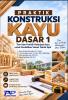
TS26-4 Basic Wood Construction Practice 1
Keywords:
Basic Wood Construction Practice, Basic Timber Construction, Timber ConstructionSynopsis
The textbook *Basic Wood Construction Practice 1: Woodworking Theory and Practice for Civil Engineering Vocational Education*—authored by Steven Richard Kamurahan, S.T., M.Ars., in collaboration with Ir. Trio Pendekar Lonan, S.T., M.T., Vicky Alexander Assa, S.ST., M.T., and Ahmad Yani Abas, S.ST., M.T.—was developed to support the "Woodworking Practice 1" course within civil engineering vocational programs. The book integrates theoretical explanations with guided practice using a Project-Based Learning approach, progressively guiding students from an understanding of Occupational Health and Safety (OHS) and the characteristics of wood as a construction material to mastering skills such as planing, sawing, mortising, tapering, and joining wood using both manual and semi-mechanical methods.
The material is presented across fifteen chapters that align with ten job sheet stages (Tasks 1–10) in accordance with the course's Semester Learning Plan. The content begins with an introduction and OHS (Chapters 1–2); moves to an overview of wood as a raw material, hand tools, measuring instruments, and woodworking machinery (Chapters 3–4); covers basic planing and sawing exercises (Chapter 5); details the fabrication and assembly of a wooden mallet (Chapters 6–7); addresses the concepts and practices of straight-lapped and oblique-lapped joints with hooks (Chapters 8–10); covers finishing processes such as sanding and painting (Chapter 11) and woodworking machine operation (Chapter 12); includes a final project involving the construction and finishing of a tool storage box (Chapters 13–14); and concludes with learning evaluation and workshop maintenance (Chapter 15). Each chapter follows a standard structure comprising learning objectives, theoretical explanations, occupational health and safety (OHS) aspects, lists of tools and materials, work procedures, assessment criteria, summaries, and formative exercises; it is also accompanied by printable shop drawings for use as workshop references. This progressive structure is designed to systematically build the technical competence of early-semester students while instilling precision, discipline, and a culture of workplace safety.
Intended for students, lecturers, and instructors in Civil Engineering vocational education, this book serves a dual purpose: as a self-study guide and as a reference for conducting standardized wood workshop practical sessions, aligning with workforce competency requirements in the road and bridge construction sector.
Downloads
References
Asrib, A. R. (2024). Konstruksi Kayu. Tahta Media Group.
Aulia, S. N., & Rahayu, S. (2025). Analisis keselamatan dan kesehatan kerja (K3) melalui metode HIRADC dan JSA. Menara: Jurnal Teknik Sipil, 20(2), 117–126. https://doi.org/10.21009/jmenara.v20i2.53130
Badan Standardisasi Nasional. (2013). SNI 7973:2013 tentang spesifikasi desain untuk konstruksi kayu. BSN.
Daryanto. (2012). Keterampilan kejuruan kerja kayu.
Darmono. (2010). Aplikasi teknik finishing mebel dengan bahan berbasis ramah lingkungan.
Inotek, 14(2), 208–223.
Forest Products Laboratory. (2021). Wood handbook—Wood as an engineering material (General Technical Report FPL-GTR-282). Madison, WI: U.S. Department of Agriculture, Forest Service, Forest Products Laboratory.
Frick, H. (1982). Ilmu konstruksi bangunan kayu. Kanisius.
Frick, H., & Moediartianto. (2019). Ilmu konstruksi kayu. Yogyakarta: Kanisius.
Glass, S. V., & Zelinka, S. L. (2021). Moisture relations and physical properties of wood. In R. J. Ross (Ed.), Wood handbook—Wood as an engineering material (General Technical Report FPL-GTR-282). Madison, WI: U.S. Department of Agriculture, Forest Service, Forest Products Laboratory.
Green, D. W., Winandy, J. E., & Kretschmann, D. E. (1999). Mechanical properties of wood. In Wood handbook—Wood as an engineering material. Madison, WI: U.S. Department of Agriculture, Forest Service, Forest Products Laboratory.
Jurusan Teknik Sipil. (2021). Standard Operating Procedure (SOP) Laboratorium Kayu.
Kaselle, H., Trisnawathy, & Fattah, M. A. (2020). Karakteristik dan sifat mekanik kayu sebagai bahan konstruksi.
Kementerian Tenaga Kerja dan Transmigrasi RI. (2010). Peraturan Menteri Tenaga Kerja dan Transmigrasi Nomor PER.08/MEN/VII/2010 tentang Alat Pelindung Diri. Diakses pada 16 Agustus 2026, dari https://jdih.kemnaker.go.id/asset/data_puu/peraturan_file_PER08.pdf
Nofrial. (2012). Finishing kayu dari bahan alam. CORAK Jurnal Seni Kriya, 1(1), 26–41.
Nugrahadi, G., & Handayani, T. (2023). Peningkatan keterampilan membuat peralatan rumah tangga berbahan baku kayu bekas. Jurnal Pengabdian kepada Masyarakat, 8(2), 112–120.
Jurusan Teknik Sipil. (2025). Rencana Pembelajaran Semester Mata Kuliah Praktik Kerja Kayu 1.
Jurusan Teknik Sipil. (2024). Jobsheet Praktik Kerja Kayu 1. Manado: Laboratorium Kerja Kayu.
Jurusan Teknik Sipil. (2024). Standard Operating Procedure (SOP) Laboratorium Kayu.
Pratama, A. Y., & Wibowo, H. (2020). Pengembangan kompetensi mata kuliah Struktur Kayu di Program Studi Pendidikan Teknik Bangunan. INVOTEC: Jurnal Inovasi Vokasional dan Teknologi, 20(1), 45–54.
Purba, E. D., Sinaga, A. A., Purba, D. J., Simamora, R. R., & Pasaribu, W. F. (2025). Pemberdayaan bengkel kayu UMKM melalui implementasi mesin pemotong kayu berdaya listrik rendah. Jurnal Pengabdian Masyarakat Sapangambei Manoktok Hitei, 5(2), 404–414.
Ross, R. J. (Ed.). (2021). Wood handbook—Wood as an engineering material. General Technical Report FPL-GTR-282. Madison, WI: U.S. Department of Agriculture, Forest Service, Forest Products Laboratory.
Simpson, W., & TenWolde, A. (1999). Physical properties and moisture relations of wood. In Wood handbook—Wood as an engineering material. Madison, WI: U.S. Department of Agriculture, Forest Service, Forest Products Laboratory.
Setiawan, B., & Purnomo, A. (2025). Peningkatan keterampilan menggunakan peralatan bengkel kayu melalui pelatihan pembuatan rak sandal. Jurnal Bakti Masyarakat Indonesia, 8(3), 501–509.
Sushardi, & Hadi, D. S. (2023). Perbaikan sifat perekatan kayu sengon dengan perlakuan permukaan. Jurnal Wana Tropika, 13(1), 1–8. https://doi.org/10.55180/jwt.v13i1.595
Susanto, E. (2021). Konstruksi Kayu: Sambungan dan Hubungan Kayu untuk Bangunan (Edisi revisi). Yogyakarta: Andi Offset.
Sutanto, R. R., Sucahyo, & Nugroho, N. (2018). Desain kekuatan sambungan geser tunggal menggunakan paku pada lima jenis kayu Indonesia. Jurnal Teknik Sipil, 25(1), 25–32. https://doi.org/10.5614/jts.2018.25.1.4
Wiedenhoeft, A. C., & Eberhardt, T. L. (2021). Structure and function of wood. In R. J. Ross (Ed.), Wood handbook—Wood as an engineering material. Madison, WI: U.S. Department of Agriculture, Forest Service, Forest Products Laboratory.
Tampi, R. W., Kamurahan, S. R., Baco, D. A., Karundeng, A., Sari, D. P., & Tendean, C. (2025). Rencana Pembelajaran Semester Praktek Kerja Kayu 1. Jurusan Teknik Sipil.
Tim Pengampu Praktik Kerja Kayu 1. (2025). Jobsheet Praktik Kerja Kayu 1. Jurusan Teknik Sipil.
Wibowo, A., & Santoso, R. (2024). Analisis penerapan Keselamatan dan Kesehatan Kerja (K3) pada bengkel kerja kayu Pendidikan Vokasi. Jurnal Teknik Sipil dan Lingkungan, 9(1), 55–66.
Yulianto, D., & Prasetya, F. (2017). Pengembangan jobsheet praktik kerja kayu berbasis kompetensi untuk mahasiswa pendidikan teknik bangunan. Jurnal Pendidikan Teknik Sipil dan Perencanaan, 17(2), 77–90.